Restaurant Consulting
Brand & Operations & Design
Services
Restaurant Branding
We define what your brand stands for, who it’s for, and what guests should expect. Every operational and design decision that follows gets checked against it. Branding is where The Alignment Framework starts.
What restaurant branding looks like here
Restaurant branding is the work of deciding what a concept stands for, who it serves, and what guests should expect, before anyone draws a floor plan. These are working sessions with all your team’s stake holders. It produces a Brand Architecture document, and every decision that follows gets checked against it.
When the brand isn’t clear, every decision after it is just a guess
Years before starrdesign existed, Steve designed a restaurant in Charlotte that won design awards critical acclaim, and served phenomenal food. Yet the restaurant still wouldn’t survive its five-year lease. The design wasn’t the problem. It just so happened to be an upscale martini bar in a part of town that was filling up with families. The restaurant was answering the wrong question, beautifully.
That’s the work branding does. Before anyone talks about what a space should look like, we figure out what the concept needs to stand for, who it’s built for, and whether those two things match the market it’s sitting in.
In our 35+ years, we’ve never worked with a restaurant that didn’t name quality as a brand principle. Quality is the price of entry. The work starts after it. What does quality mean here, and what would a guest have to see, taste, and feel to believe it?
What’s included
A working session, not a deck handed to you
Brand Discovery is collaborative on purpose. Everyone who has a say in how the brand behaves sits in the same room and works through it together. The most valuable moment usually arrives when the CEO describes the brand one way, and the operations lead says that isn’t quite how it works. That gap is the point. Raising it in a working session costs only a conversation, whereas raising it during construction costs a change order.
We brand for brick and mortar
Your building is your largest cost and your largest asset. It’s also talking to guests before anyone reads a menu. We make every brand decision with the real world in mind: can you build it, staff it, and repeat it at location two, twenty, and two hundred?
“the number one cause of restaurant failure in the U.S. is undercapitalization. The number two cause is customer confusion. I can’t fix the first one. I can absolutely fix the second.”
- Steve Starr, AIA, FCSI
Branding is the first of five steps, and it doesn’t run alone
Brand Discovery is one of two workstreams in Strategize, the first of five steps in The Alignment Framework. While it runs, we also conduct a Strategic Operations Analysis of the kitchen, workflow, and guest journey.
We finish both the Brand Discovery and the Strategic Operations Analysis before we draw the first line. This produces a Design Brief that gives us one roadmap to guide the architecture, interiors, and graphics.
The brand establishes what guests expect. The operations deliver on it. The design reinforces both.
If you already work with a marketing agency, keep them
This isn’t a social media strategy or a campaign calendar. We’re answering a narrower question: how does your brand strategy get aligned with your operations and your design, and how does it show up in the building?
When a marketing firm has already done brand work, we take it, run it through our format, and look for any gaps between what the brand promises and what the operation and the space can actually deliver.
What brand clarity is worth

Tupelo Honey
40% sales increase
Tupelo Honey had a beloved brunch reputation, a weak bar, and soft dinner numbers that were capping growth. We reworked the brand positioning and the physical space together, moving the concept from homegrown brunch destination to polished casual Southern. Sales rose 40%, driven by bar and dinner. That performance unlocked access to A-level real estate in major markets and made national expansion viable.
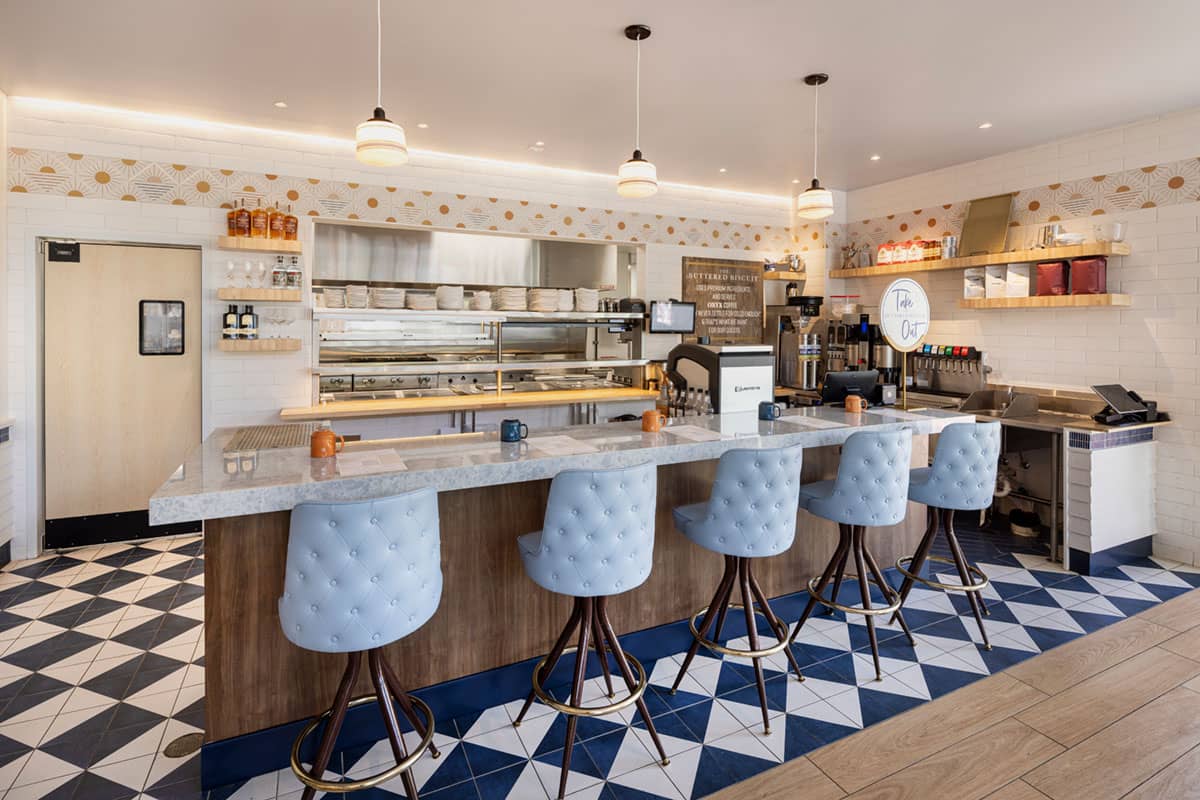
The Buttered Biscuit
33% above projected sales
The expansion prototype we designed for The Buttered Biscuit was engineered to support $45,000 in weekly revenue. It opened 33% above projected sales and regularly clears $60,000 a week without straining the operation. That came from doing the brand work first, defining the concept as scratch-made food in a place that feels like home, before anyone touched the kitchen or the floor plan. FCSI 2025 Project Showcase recognized the partnership.
No silos, no handoffs
Foodservice Consulting runs alongside branding in Strategize, the first step.
Architecture and Interior Design turn the brand into a building guests can read.
Graphics make the brand messages and the wayfinding clear from the parking lot forward.
Just getting started?
Frequently Asked Questions
brands we helped
build & scale:











Let’s talk about what your brand actually stands for
Tell us where you are and where you want to go.
No pressure, no obligation.