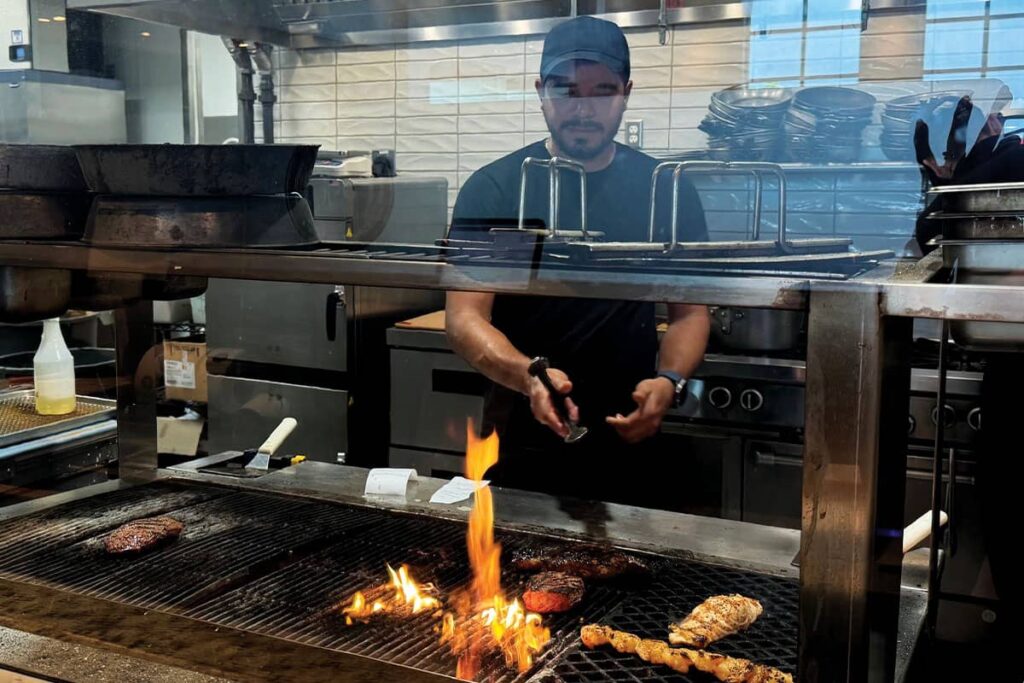
Firebirds Wood Fired Grill’s latest prototype began with a comprehensive review, questioning the value of every aspect of the design.
The original layout for Firebirds Wood Fired Grill, a Charlotte, N.C.-based steak and seafood concept, had served it well in more than 50 locations, evolving across three prototypes. And then, it didn’t.
“Guests know Firebirds as a spacious restaurant with the display wood-fired grill, its signature Firebar, a range of seating styles and a patio with a fireplace,” says Steve Starr, principal for Starr Design, also in Charlotte, who has helped design Firebirds restaurants since its founding in 2000.
For its first two decades, Firebirds restaurants featured a 7,000-square-foot footprint. But in 2017, rising construction costs became a major issue. “We saw double-digit price increases [for steel and equipment] for three years in a row,” Starr recalls.
The Firebirds team began value-engineering its third-generation prototype, exploring alternatives to everything from equipment to building materials. It still wasn’t enough. In 2021, Firebirds then-new CEO Steve Kislow asked for a more cost-effective alternative.
Starr, together with Firebirds’ Director of Design and Construction Daren Knight, spearheaded development of the company’s fourth and most innovative prototype.
“The real story of Firebirds’ new prototype was the process more than the specific changes,” Starr says. “Firebirds’ leadership gave the team free rein to challenge everything based on value rather than cost. Through this process, [which included cutting 1,000 square feet and reducing building costs by about 15%], we made a few big changes and countless small changes that delivered significant results.”
The fourth-generation prototype, along with backing from Garnett Station Partners, which acquired Firebirds in March 2023, has revitalized the chain’s expansion. The first location opened last fall in Murfreesboro, Tenn., followed by two in Texas (the Grapevine location pictured throughout this story) and one in Arizona.
“The 61st Firebirds will open in late July,” Kislow says. At press time, four units were under construction, with seven more openings expected in 2025.
Sales at Firebirds’ new compact locations have exceeded expectations. “With the added off-premise business, our smaller footprint can do as much volume as the larger legacy footprint,” Kislow says. “The more efficient [design] adds energy to the dining rooms, where [guests] can better hear the music, and lighting and temperature are easier to regulate, allowing the team to better manage the dining experience.”
Employees approve of the new design. “When we prepare to open each new restaurant, [we’re seeing] a friendly competition among [managers as to] who will take the helm in one of these beautiful new buildings,” Kislow adds.
Anatomy of a Makeover
To make such a radical departure from Firebirds’ legacy stores, Knight and Starr agreed the only solution would be to, in some ways, start from scratch.
“We looked at everything, including the layout, key features, equipment, lighting, FF&E, and even the framing and footprint of the building,” Starr says. “We evaluated which big-ticket items [we could drop or change] while maintaining Firebirds’ three signature elements: the expo line, its wood-fired grill and the bar’s colorful ‘waterfall’ bottle display.”
Firebirds’ fourth-generation prototype features bone-deep changes to its building, interior layout, bar, to-go area and patio.
BUILDING. One of the early updates involved the building envelope. “We changed from a steel-frame construction model to an all-wood frame,” says Starr, noting soaring steel prices in 2021 and 2022 (due to pandemic-related shortages and the war in Ukraine) made this an easy decision. The shift to wood saved about $100,000.
Next, the team looked at simplifying and reducing the footprint.
“What [connected] the first three prototype interiors was an intentional sequence of presentation that [required a lot of space],” Starr says. “As you walked in, you’d see the Firebar first. Your second view when you turn the corner was, on the far side of the dining room, the wood-fire grill in the expo kitchen.”
The fourth prototype took a new approach. “We went from a large, complicated building with jigs and jogs, to a 1,000-square-foot smaller box with add-ons for the vestibule and walk-ins. It became significantly easier and faster to build,” Starr says.
Most trims came from the dining area, public space and table groupings. “In the previous prototypes, traffic moved in all different directions, requiring more circulation space,” Starr recalls.